
On a dating site, “free” may mean a profile and a stack of faces, with no way to read or send the message that matters. Women over 65 should use free access as a communication test: join only where the current free tier lets you assess nearby matches and exchange enough messages to judge interest without a subscription surprise. Put Match and eharmony on that test sheet, but do not trust the names blindly.
Published by Dating Online
Free access often comes with meaningful communication limits
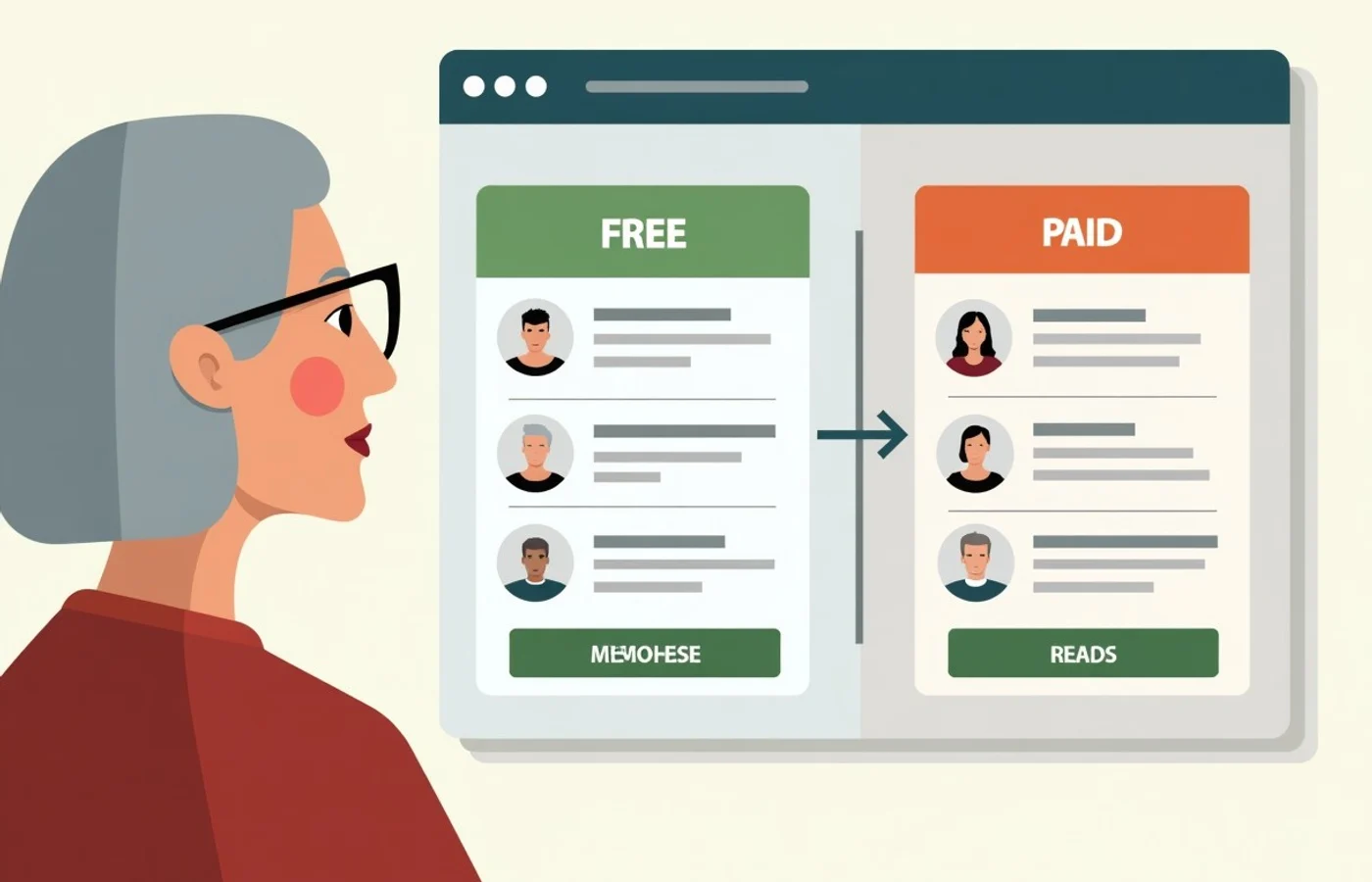
“Free” is often a storefront label, not a communication promise. A free account may let you create a profile, browse, set an age range, set distance, or send a like, while reading a reply or sending the first note sits behind membership. That split matters more than a polished search page. When two people cannot exchange enough information to decide on a call, the free tier is advertising, not a dating option.
On the current account and membership pages for Match and eharmony, list five functions separately: browsing, matching or likes, reading incoming messages, sending messages, and age or distance filters. Mark each as free, paid, or unclear; count unclear as unavailable. A service whose free account only displays profiles does not belong on a free-first shortlist. Reciprocal messages are the dividing line.
Signs a platform has a relevant and active match pool
The first costly mistake is mistaking a large national catalog for a local dating pool. Set an age range you would actually date and a distance you would actually travel. On the first evening, count profiles in that slice, note any recent-activity markers shown, and check how many have photos and completed basics. A list dominated by blank accounts or people far outside your chosen range fails the test, regardless of the name.
How much response testing is enough? Two or three initiated contacts, where the free tier permits them, exposes a basic problem. Silence has several explanations; a paid wall that stops a reply is a direct answer. The match pool also has to work on the device you use. Open search, profile details, filters, block or report controls, and account settings on a phone. Then sign in on a computer if that is where you prefer to read and write. Small text, hidden filters, or menus buried behind icons turn a promising pool into a chore.
When a promising match asks to leave the site quickly

Moving from a dating site to text or email immediately removes the account tools that matter most. For Match, eharmony, and any other contender, check the help and account pages for profile data controls, a block function, a reporting route, and an explanation of any identity or photo verification. Drop a service from consideration when this documentation is missing.
A verification marker shows that the platform completed a process; it says nothing conclusive about character or intentions. Keep early exchanges inside the service until sharing contact details feels warranted. Repeated demands after a refusal justify blocking or reporting. Free accounts should still include these controls; a paid label does not excuse their absence.
Subscription terms and the final shortlist
Subscription terms deserve the same scrutiny as messages. On each contender’s payment screen and terms page, write down the current price, membership period, trial restriction, automatic-renewal date, cancellation route, and cutoff that stops the next charge. A price revealed only after several screens, or cancellation instructions buried in help pages, weakens the case for paying.
Two sites are enough for a shortlist. Keep Match, eharmony, or another named service only if your notes show a working free communication route, a credible nearby age pool, easy phone or computer use, and clear data controls. Pay only after checking those points.
Free access is useful when it lets you review profiles, send messages where it matters, and leave without an obscure charge. A paid upgrade has one narrow justification: the free account already produced nearby, age-appropriate profiles, and the purchase page clearly states recurring terms and the cancellation deadline. Leave anything short of that off the shortlist.