
Engineers weighing a career-branded dating service against a mainstream app should inspect the service’s controls before its professional pitch. A safe singles site for engineers earns a trial when it limits exposure of employer and location details, provides a direct route for reporting abuse, and explains account deletion without vague fine print. Compare published policies first, then test a free account using a broad job description. The League and EliteSingles offer career- or education-focused comparison points; Hinge, Bumble, and Coffee Meets Bagel represent broader dating pools.
Published by Dating Online
Professional labels do not prove that a singles site is trustworthy

Career-focused branding describes an audience, not a security credential. The League’s professional orientation and EliteSingles’ educated-singles positioning tell you who each service seeks to attract. They do not establish who owns the service, how members are checked, which misconduct triggers action, or how profile information reaches advertising partners. An engineering label is particularly thin when it rests on salary, school, or job-title claims with no explanation of how those claims are handled.
Before an account exists, the site should identify its operating company, terms, privacy notice, safety center, community rules, and reporting instructions. A stated verification process needs boundaries: whether it covers an email address, a photo, government identification, or only a member assertion; how often it occurs; and what it fails to catch. Hinge publishes a dedicated safety resource. That is a stronger starting point than a bare verification badge, though the report route, account controls, and terms still determine whether the service deserves your time.
Warning signs reveal weak verification and moderation
Moderation shows up in the details a site makes available before trouble starts. Warning signs include a vague safety page, no listed report categories, a support channel with no stated response path, and badges that never explain who issued them or what they confirm. Profiles using the same portrait and biography under different names also deserve a report, not a debate.
Report menus should cover impersonation, harassment, scam solicitation, underage use, and suspicious content. Identity checks narrow one route to deception, but they do not establish a person’s relationship status, intentions, or financial honesty. The Federal Trade Commission’s romance-scam guidance is relevant on every service: requests for money, pressure to move off the app quickly, and elaborate emergencies belong in the report queue.
When employer, project, or location details could identify you
An employer name, exact title, project description, and worksite can identify a person long before a match earns that access. A broad line such as “engineer in public infrastructure” says enough for an early profile. A department name, client reference, clearance hint, shift roster, patent work, or photograph taken beside a company sign says far more than most daters need.
Location settings deserve the same restraint. A narrow radius around a small plant, laboratory, campus, or field office narrows the search to a workplace map. The profile editor should show whether a location appears as a city, neighborhood, distance range, or precise point, along with who sees it. Photos deserve a separate pass for badges, vehicle plates, floor plans, whiteboards, building entrances, and conference lanyards. Those details often reveal an employer even when the profile text does not.
Privacy permissions and account-exit terms
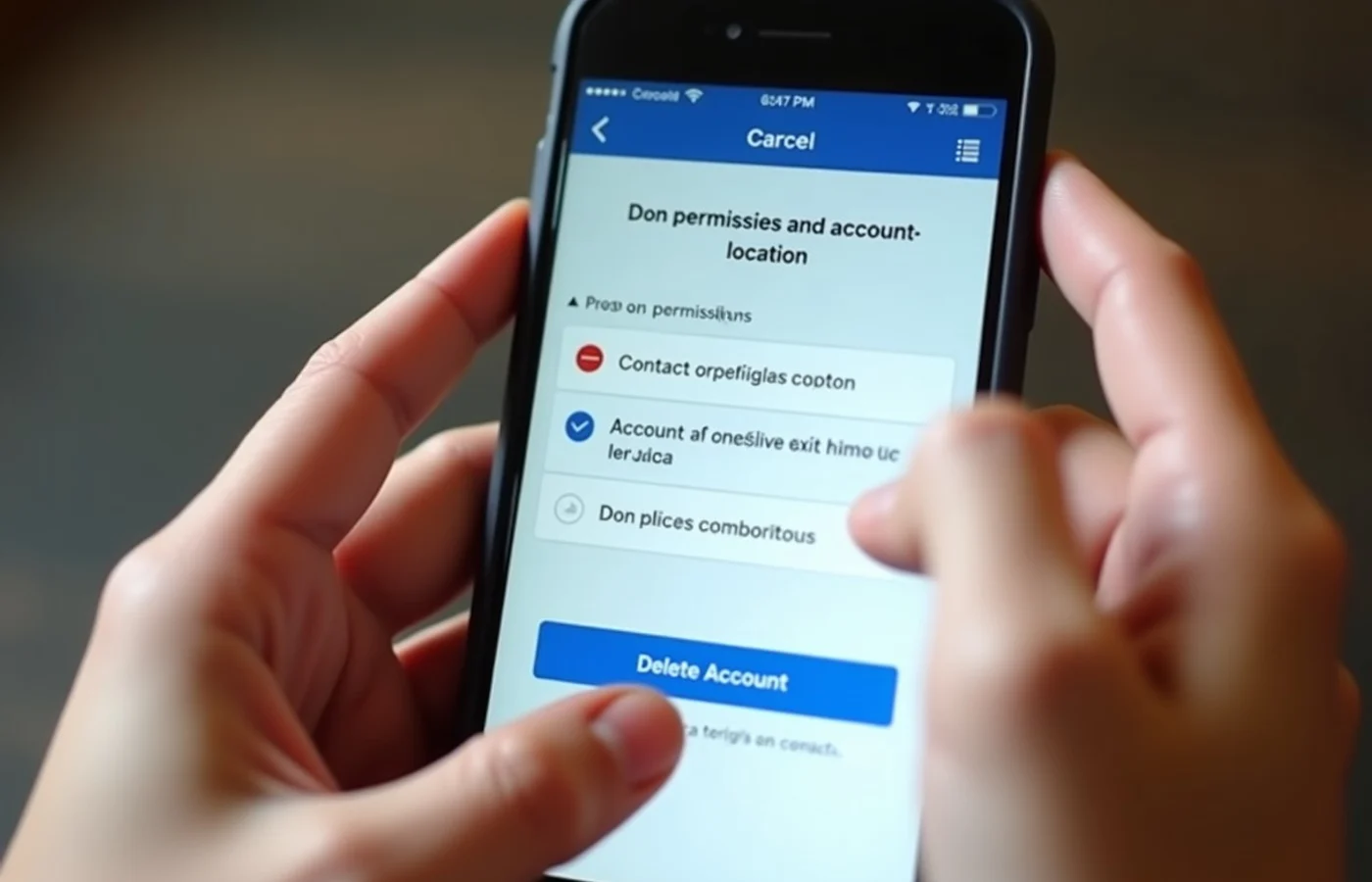
Permission screens govern what a dating service receives from your phone, while the privacy notice explains what happens afterward. Current privacy notices and help pages should answer whether the app requests contacts, collects precise location, uses information for targeted advertising, retains deleted-profile data, or shares information with affiliated companies and service providers. A request for contacts deserves close scrutiny; it creates an unnecessary bridge between a personal dating account and a professional network.
Account deletion and subscription cancellation are separate questions. The help documentation should state how to remove a profile, what data remains after deletion, whether a subscription renews, and where cancellation occurs for purchases made through an app store. A site that buries those answers behind customer support or account menus has introduced friction at exactly the point where members need a clean exit.
Test the site before revealing professional details
- Checkpoint: Basic profile Test: Use a first name, general field, broad city area, and photos with no employer markers. Leave company, worksite, project, and exact title out.
- Checkpoint: Match quality Test: Browse profiles for completed bios, relationship intentions, and signs that suggested matches fit your stated age range and distance. Thin or repetitive profiles weaken the case for paying.
- Checkpoint: In-app contact Test: Exchange a small number of ordinary messages without moving to text, email, or social media. Note whether profiles push links, investment pitches, emergency stories, or immediate off-app contact.
- Checkpoint: Safety and settings Test: Find the report option, block control, profile visibility settings, location precision control, and help documentation while no problem is underway. Hidden tools are poor tools.
- Checkpoint: Support and exit Test: Send one straightforward account question before payment, then locate deletion and cancellation instructions. Join or pay only when the match pool and account terms both hold up; leave when either one does not.
Niche engineering communities or larger dating platforms
A career-oriented service puts work and education closer to the front of profile context. That shared shorthand may appeal to engineers who want a partner familiar with demanding deadlines, on-call rotations, travel, or graduate-school commitments. The narrower premise also risks a thin set of suitable profiles, particularly for a specialized field, a smaller dating radius, or a person seeking a relationship beyond professional common ground.
Hinge, Bumble, and Coffee Meets Bagel deserve comparison because their audiences are not limited to one occupation. Broader services expose people outside engineering, which matters when values, relationship plans, humor, family life, and available evenings carry more weight than a matching degree. Hinge’s published safety resource also offers a public documentation benchmark when judging other services.
For most engineers, a free side-by-side trial of one career-oriented service and one broad app is the sounder route. Test whether each service lets you state schedule realities without publishing a roster: weekend availability, rotating shifts, travel weeks, or limited evening time. A professional label has value only when the profiles, controls, and terms remain strong after that test.
Before you move on
Should I use a work email address for a dating account?
No. A personal email separates the account from an employer system and limits what a dating service learns about your workplace. It also avoids trouble if you change jobs or lose access to a company inbox.
Are conference photos appropriate for a dating profile?
Conference photos often reveal a badge, event location, employer logo, colleague names, or a regular travel schedule. A cropped image without those details is safer, though a photo unrelated to work reveals less.
How should an engineer describe on-call work?
On-call work belongs as a broad availability note, such as limited weekday evenings or occasional schedule changes. It does not require a shift calendar, site name, client, team name, or explanation of restricted work.
Professional common ground is a bonus, not a reason to surrender workplace details. A dating service earns trust through plainly stated verification limits, reachable reporting, restrained data access, and a deletion path that does not become a scavenger hunt. Keep the first profile broad, test the account before payment, and let personal details emerge only after the service itself has cleared a basic standard.
Sources for this guide
- Coffee Meets Bagel — official information — Coffee Meets Bagel
- Federal Trade Commission — official information — Federal Trade Commission
- Federal Trade Commission — official information — Federal Trade Commission
- Hinge — official information — Hinge
- Hinge — official information — Hinge
- Bumble — official information — Bumble